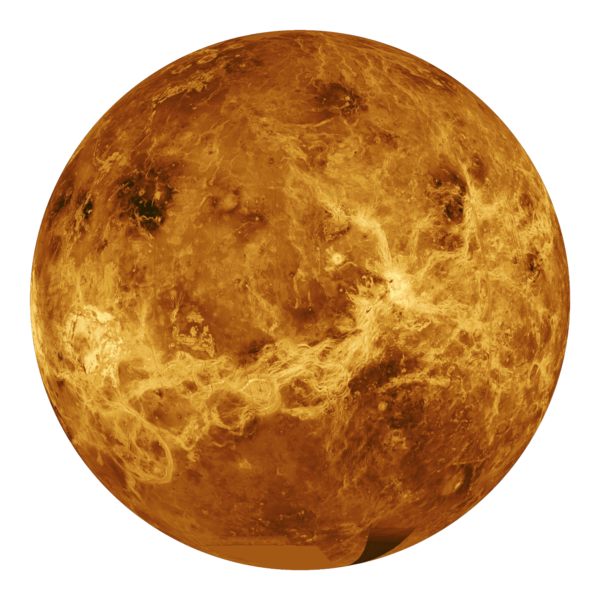
Venus is the second planet from the Sun and the closest planet to Earth.
Venus has a thick atmosphere that is mostly made up of carbon dioxide and nitrogen.
The planet's surface is incredibly hot, with temperatures that can reach up to 864 degrees Fahrenheit (462 degrees Celsius).
Unlike the other planets in our solar system, Venus spins clockwise on its axis.
Venus is often called the "morning star" or the "evening star" because it is visible in the sky just before sunrise or just after sunset.
Venus is about the same size as Earth, but its surface is much different, with no oceans and a landscape covered in volcanoes and mountains.
Venus has no moons or rings.
Because of its thick atmosphere, Venus experiences a greenhouse effect that makes it the hottest planet in the solar system, even hotter than Mercury, which is closer to the sun.
Venus rotates very slowly, taking about 243 Earth days to complete one rotation, which is longer than its year.
Several spacecraft have been sent to Venus to study the planet, including the Soviet Venera missions and the American Magellan mission.