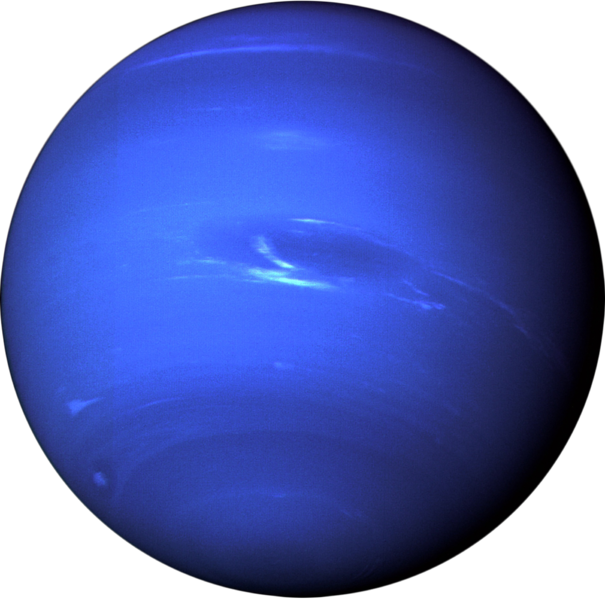
Neptune is the eighth and farthest planet from the Sun in the solar system.
Neptune is a gas giant, made mostly of hydrogen, helium, and methane.
Neptune has 14 known moons, the largest of which is Triton.
Neptune's atmosphere is very active, with strong winds and large storms, including the Great Dark Spot, which was visible from Earth in the late 1980s.
Neptune has a very thin set of rings, which were first discovered in 1984 by the Voyager 2 spacecraft.
Neptune's rotational axis is tilted at an angle which causes extreme seasonal variations in its weather.
Neptune's temperature is very cold, with temperatures at the cloud tops around -218°C (-360°F) and temperatures at the core estimated to be around 7,000°C.
Neptune has been visited by only one spacecraft, Voyager 2, which flew by the planet in 1989 and provided the most detailed images and data of the planet to date.
Neptune's year is equivalent to about 165 Earth years, but its day is only about 16 hours long.
Neptune is not visible to the naked eye from Earth and was the first planet to be predicted to exist by mathematical calculations before it was observed by a telescope in 1846.