Sun
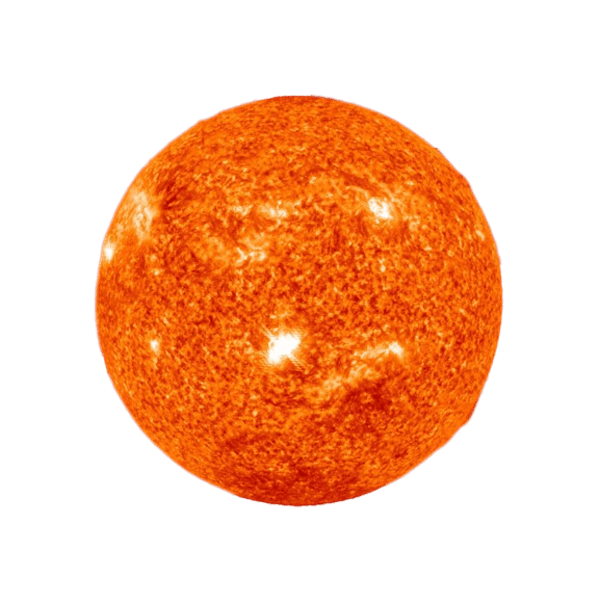
The Sun is the star at the center of our solar system. It is a massive, luminous ball of hot plasma, with internal convective motion that generates a magnetic field. The Sun provides light and heat to the Earth, which is essential for supporting life. It is also the largest object in our solar system, accounting for more than 99% of the total mass.
- The Sun is so large that more than 1 million Earths could fit inside it.
- The Sun is about 4.6 billion years old and has about 5 billion years of life left.
- The Sun's energy is produced by nuclear fusion, where hydrogen atoms combine to form helium.
- The Sun's surface temperature is about 5,500 degrees Celsius.
- The Sun rotates on its axis once every 24.47 Earth days.
- The Sun's magnetic field is responsible for producing sunspots, which are temporary dark spots on its surface.
- The Sun emits solar flares, which are bursts of high-energy particles that can disrupt satellite communications and power grids on Earth.
- The Sun's gravity is so strong that it keeps all the planets in our solar system in their orbits.
- The Sun's atmosphere is composed of several layers, including the photosphere, chromosphere, and corona.
- The Sun will eventually run out of fuel and turn into a red giant, expanding to the point where it will engulf Mercury, Venus, and possibly Earth.